
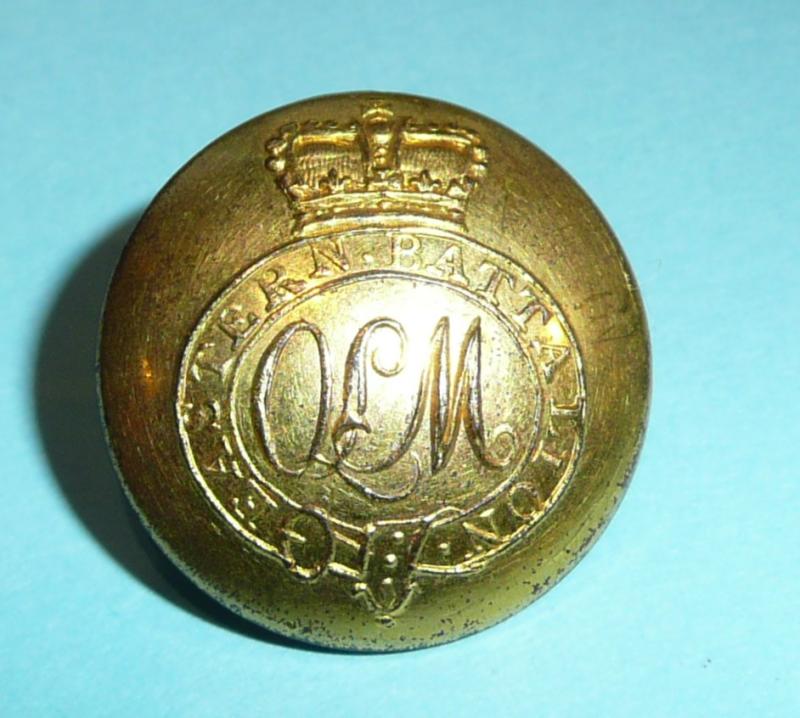
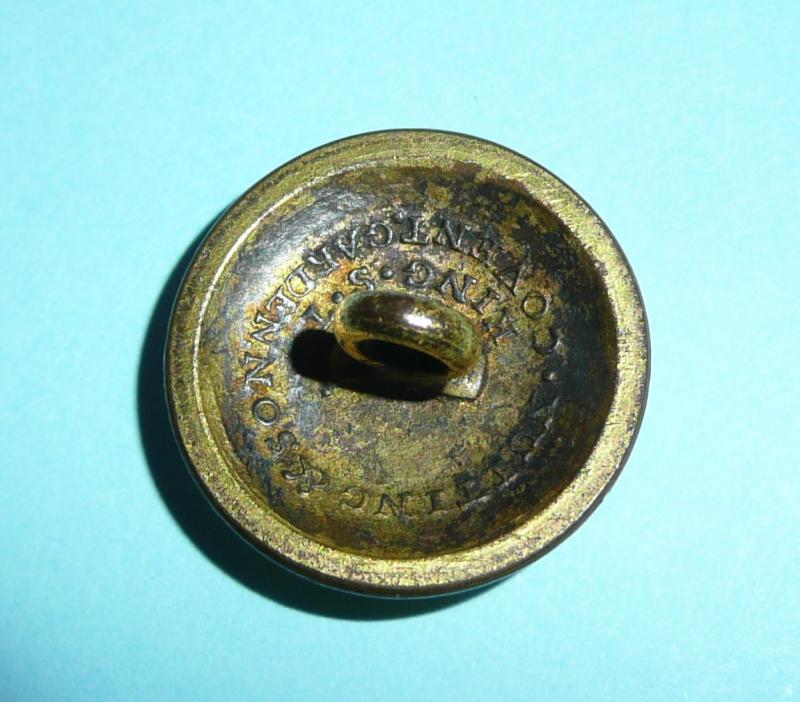
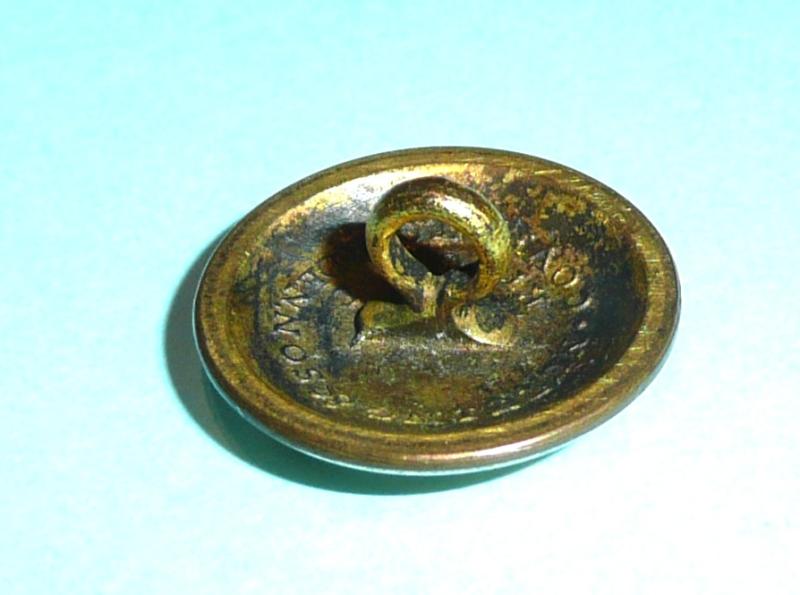
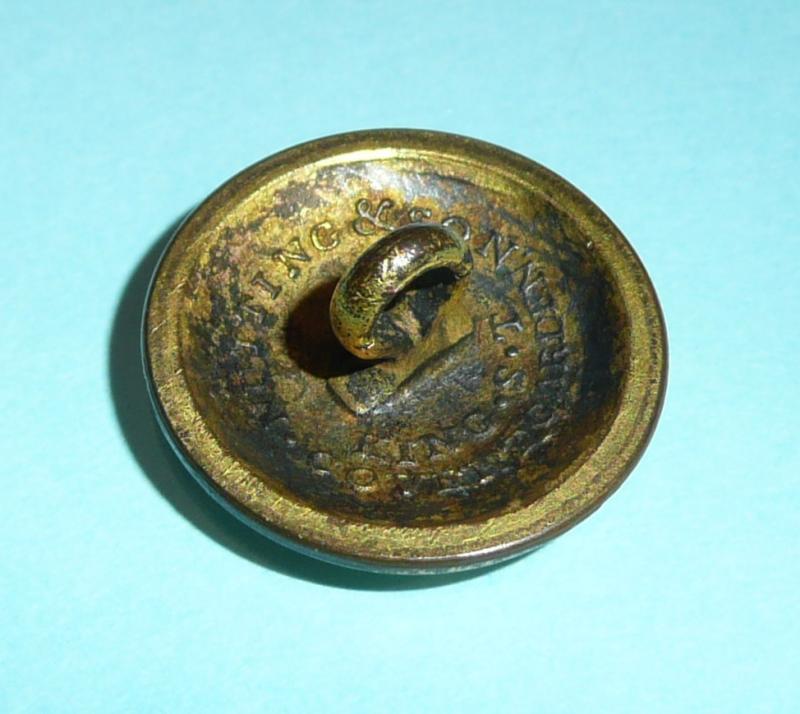
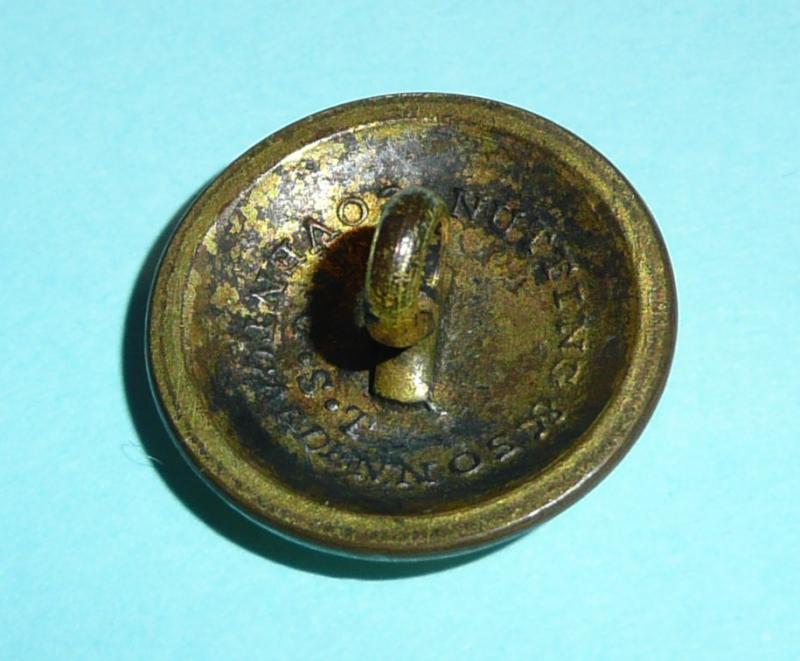
Georgian / Napoleonic Oxfordshire Eastern Battalion Local Militia Officer's Gilt Open Backed Tunic Coatee Button
Circa 20mm in diameter, convex open-backed button, gilt in superb condition. Fixed shank. Maker marked Nutting & Son, King Street, Covent Garden. Circa 1809 - 1815. Rare.
A found an interesting article which describes the process by which these beautiful gilt buttons were made, reproduced below for your interest:
To make metal buttons a mould was made by pressing a pattern for multiple buttons into sand. The shanks were pressed into the sand in the centre of each impression, then molten mixture of brass with tin and sometimes zinc was poured into the casting. When cooled, the sand was brushed off, and the individual buttons snapped apart. One workman would lathe the edges, another the backs, and another the front. This was followed by polishing with leather and “rotten stone” (a finely powdered porous rock) by women. Buttons were dipped into a solution containing tin to coat the buttons to “render the buttons white”.
Gilt buttons were formed by stamping out from sheet copper (sometimes alloyed with a small amount of zinc). The blanks were softened by heating in a furnace to allow the maker’s name to be stamped into the back, and also to make the face slightly convex. The shanks were then soldered on. After smoothing the edges the buttons were burnished smooth with “bloodstone” (an iron containing quartz) before gilding.
The prepared buttons were then placed in an earthernware pan containing a mixture of gold and mercury and nitric acid, then stirred until coated. The acid was washed away before the buttons were heated in a pan to melt the mercury amalgam. The hot buttons were now placed in a felt bag and stirred to spread the gold evenly before returning to the hot pan to evapourate the mercury. This process was repeated to drive off more mercury. The buttons now appeared yellow but required burnishing again with bloodstone and water in a lathe by three seperate men to do the edges, face and back. (Editor’s note: this division of labour, as well as powered tools, were the keys to England’s mastery of mass production during the industrial revolution.) Some buttons then had their edges milled, and/or circles milled upon their faces. “Double gilt buttons are gilt twice over, in the manner before described.“
As ” the drying off is exceedingly pernicious to the operator, as he inhales the vapour of the mercury, which is well known to be a violent poison” Mr. Mark Sanders, “an eminent button manufacturer of Birmingham” used a complex structure for safely collecting the mercury vapour for reuse. "
To see the full article and the the complex structure emplyed by Mark Sanders referred to above, please visit:
https://www.austbuttonhistory.com/its-un-australian/
A7.10
Code: 69531
145.00 GBP